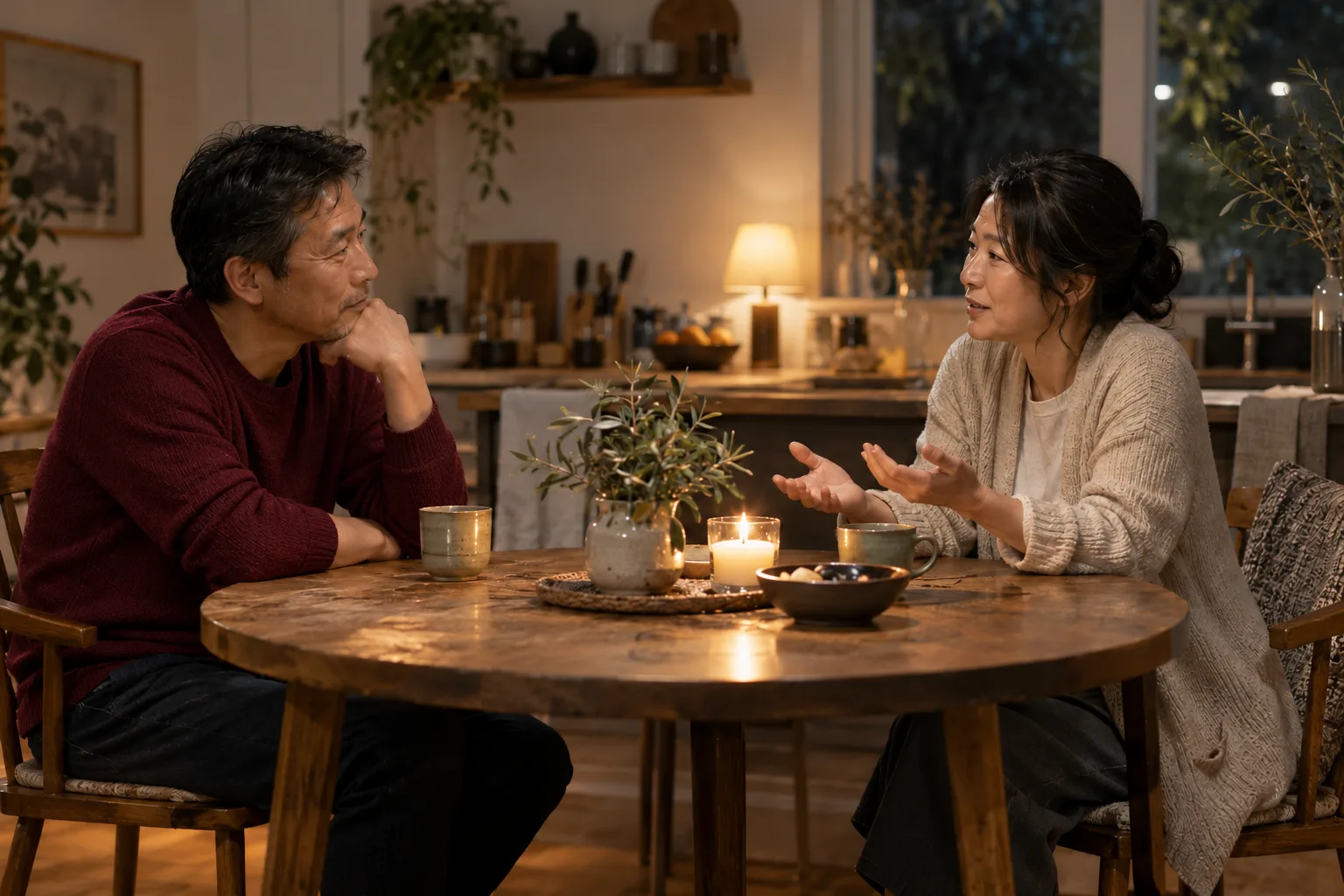
Low desire after 40: a guide for women
You still care about your partner, but sex may be the last thing on your mind. Start by understanding what the change feels like for you.

In this article
Start with your own feelings
“I love my partner. Why do I hardly think about sex anymore?” If that question sounds familiar, give yourself a moment before deciding what it means. You may miss your old interest in sex. You may feel mostly worried about letting someone down. Or both may be true.
Those feelings deserve room. Start by asking what you would like to change for yourself. Would you like more interest, less pain, less pressure, or a clearer understanding of what is happening? There's no need to choose the answer you think you should give.
Pause here. What do you actually miss?
Ask yourself: do I miss wanting sex, or do I mainly miss how easy things used to feel between us? Would I want more closeness if I knew it wouldn't lead to an expectation? Does sex sound unappealing, or does it sound uncomfortable?
Your answers may overlap. You might miss desire and still want space. You might want affection but not the kind of sex you've been having.
Try finishing this sentence: “The part I'd most like help with is…” Keep your answer in your own words. It can guide a conversation with your partner or clinician without requiring you to decide on a cause first.
What the numbers tell us
In a British study published in 2017, 34.2% of women surveyed reported lacking interest in sex for at least three months in the previous year. The data came from 2010–2012 and covered sexually active adults aged 16–74, not just women in midlife.
The figure doesn't tell us the cause for any one woman, or mean that everyone with lower interest needs treatment. It is a reminder that this is a question other people have too. A survey cannot decide what a satisfying intimate life should look like for you.
Low interest is something others report too
Women reporting low interest
6,669 women in this analysisEach dot represents one percentage point; the exact estimate is shown at left.
Lack of interest lasting at least three months in the previous year. British Natsal-3 participants aged 16–74 with a sexual partner in the past year; data collected in 2010–2012. Not a midlife-only estimate or a diagnosis. Graham et al., BMJ Open (2017).
Look beyond a single cause
The Menopause Society describes several influences on sex in midlife, including hormone changes, disrupted sleep, discomfort, and life pressures. Some women notice lower desire, some notice more, and some notice little change.
The NHS also identifies certain medicines, depression, and health conditions as possible contributors. If sex hurts, give that its own attention rather than expecting yourself to become more interested in something uncomfortable. Our guide to painful sex after 40 is a starting point.
Make a little room for yourself
Try a short reflection, without turning it into another task to do perfectly. What has changed recently? What feels draining? What kind of closeness sounds pleasant, if any? Write a few words rather than keeping a detailed score.
You can also name what you don't want. Perhaps you don't want every kiss to become an invitation. Perhaps you want privacy or time together without your phone. These are preferences to discuss, not a promise that making those changes will bring desire back.
How to explain it to a partner
Try: “I am trying to understand how I feel about sex lately. I would like us to talk without making tonight a test.” Then share one thing you know: what feels good, what hurts, or what feels pressured.
Ask about your partner's experience too, without making yourself responsible for fixing every feeling. You can be caring and still say no. Our conversation guide to different levels of desire offers more prompts, while intimacy after 40 explores closeness more broadly.
What if you’re comfortable with less sex?
Perhaps you read all this and think, “Actually, I'm okay. It's my partner who's upset.” You don't have to invent distress about your own desire. But the difference between you may still need an honest conversation.
Ask yourself what you want to preserve in the relationship and what you're willing to discuss. Then invite your partner to share the same things. Neither answer automatically cancels the other.
You can acknowledge disappointment without agreeing to unwanted sex. You can also be unsure about what comes next. If the conversation keeps going in circles, asking for qualified relationship support may give you both somewhere to talk more fully.
Getting help on your terms
If the change bothers you, discuss it with a clinician. Mention changes in sleep, mood, comfort, or medicines, and explain what you hope will improve. Do not stop a prescription on your own.
You can say, “This matters to me, and I would like to understand my options.” If an explanation is unclear, ask for simpler words and a follow-up plan. You don't need to justify wanting help with this part of your life.
Sources & further reading
- The Menopause Society — Sexual health ↗
- NHS — Low sex drive ↗
- Graham et al., BMJ Open (2017) — Lack of interest in sex in the Natsal-3 survey ↗
Read our editorial standards.